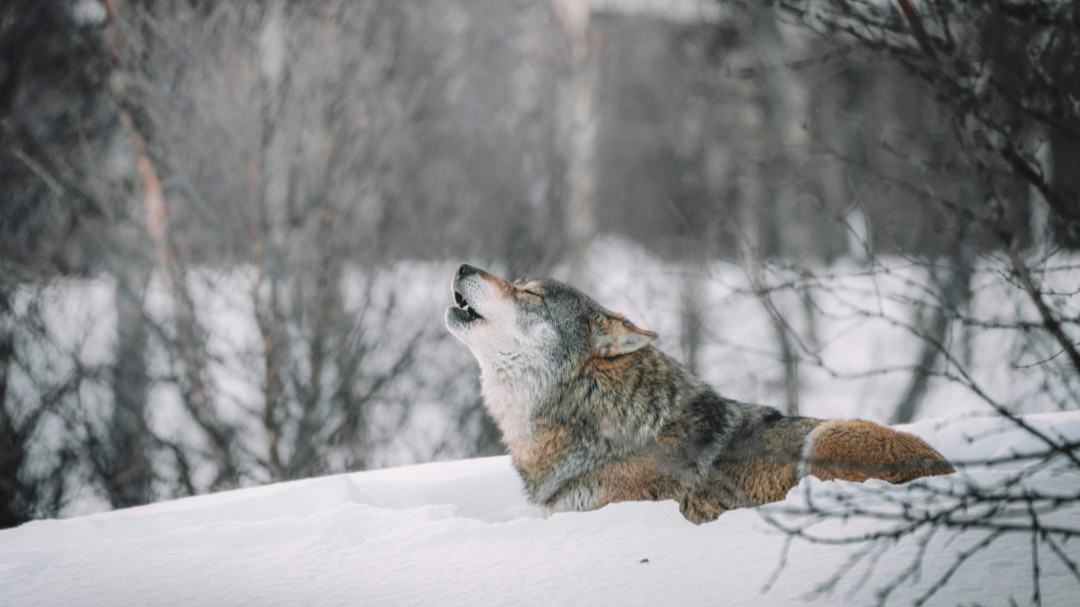
There is a well-known Native American tale about a grandfather who wanted to teach his grandson about life.
"'There's a fight going on inside me", he said. "It's a terrible fight and it's between two wolves. One wolf is full of fear, anger, scarcity and doubt. The other wolf is different. It's full of hope, courage, compassion and trust. The same fight is going on inside you and inside every other person."
The grandson thought about it for a moment and asked the grandfather, "So, which wolf wins?"
And the grandfather simply replied. "Well, the one you feed."
I love this story because it's both simple and complex. If only our lives could operate from neat little compartments with wolves in them. But they don't! We have to remind ourselves that life often happens between the lines, in the grey.
March has been a rather unsettling month. I found myself struggling to write and find my flow. When your daily routes get disrupted and uncertainty continues, it can be hard to stay motivated. Our brains are wired for safety and certainty, so anything that goes against this stimulates a protective response. That could be to fight, flight, freeze or fawn depending on how our nervous systems are wired for similar kinds of situations. When you don't know what's going on and you don't know what to do, fear can be extremely convincing! Fear feels real because the brain treats imagined danger almost like actual danger.
Sitting with uncertainty
Sitting with uncertainty feels uncomfortable and the body tightens. Uncertainty can take the form of an unanswered email, unresolved disagreements, pending decisions and test results. When the loops stay open and we don't get the clarity we seek, our brain rushes to resolve the discomfort by playing the worst-case scenarios, predicting, rehearsing old stories. This naturally leads to anxiety, difficulty with decision-making and a lot of doom scrolling. We all have different levels of tolerance to uncertainty, shaped by our childhood/lived experiences and cultural background so it's important to pay attention to these when communicating with each other.
It would be fair to say that, like most families in the UAE right now, we battled between leaving the country or staying. A few work assignments stalled while others continued. We switched to remote working and remote learning. Some of us have had the opportunity to relocate elsewhere, while others haven't. Some of us have chosen to stay. Trying to keep things normal while knowing that, in the background, things were not normal is something I've definitely experienced more than once. Conversations I had around me with friends or clients shared a mixed tone - "we feel safe (for now) but if things escalate then…" - while not really sure about the level of escalation we were waiting for.
The threat we are facing is very real at the moment so we are naturally asking ourselves whether we've made the right decision, whether we are as prepared as we think we are, what if things go wrong. This kind of situation requires constant re-evaluation, and it can be tiring.
Of course, these questions appear not only during times of adversity/life stress but also other times, for example, a job change, a parenting decision, a relationship shift. Sometimes, the same questions appear even when the threat is not real. For example, a client returning to work following maternity leave asked herself: Am I doing the right thing? What if the nanny can't soothe the baby? What if the baby starts preferring the nanny over her? None of these were actually happening but the fears, at the time, felt very real. Whatever the uncertainty, our mind builds a story around it and we stand at the same crossroads.
Slowing the story down
One of the themes in the book 'The things you can only see when you slow down' by Haemin Sunim is that clarity often arrives when we stop wrestling life into submission. When we slow down, even if it's just for one breath, our internal landscape changes. When we pause, we notice:
- What's actually happening vs what we are imagining
- The sensation in our body vs the stories in our mind
- The difference between urgency and importance
- The moments of connection and humour that fear tries to erase
- The resilience we are building without realising it
Slowing down won't magically solve our problems but it does make it easier to tell the wolves apart. The wolf of fear is loud and fierce, imagining a future that hurts us while the wolf of faith is quiet and steady, imagining a future of possibilities.
'Both faith and fear ask you to believe in something that doesn't exist. You choose'
— Bob Proctor
Both wolves are hungry and both want your attention. But I'm equally reminded by this quote by Bob Proctor that both futures are invisible and both require belief.
Every moment of uncertainty offers us a choice but we don't have to choose perfectly all the time. What we do need is to take the time to slow down. We are just one small part of a huge universe, there is very little we can control and part of our growth lies in accepting it and working with what we can control instead. There's no single right answer. There's only the choice that aligns with who you are and what you know at that point in time. Slowing down affords us the opportunity to gain perspective and pay attention to our patterns.
So pause, take a breath, notice the energy behind your feelings, feel them ebb and flow.
It helps to gently observe, when we can, which wolf we are feeding more often than not and how it is shaping the way we move through the world. We won't get it right every time, especially in moments that stretch our capacity, but perhaps there is some merit in feeding the wolf that helps us move forward with a little more courage, a little more humour and a lot of compassion (for ourselves and each other).